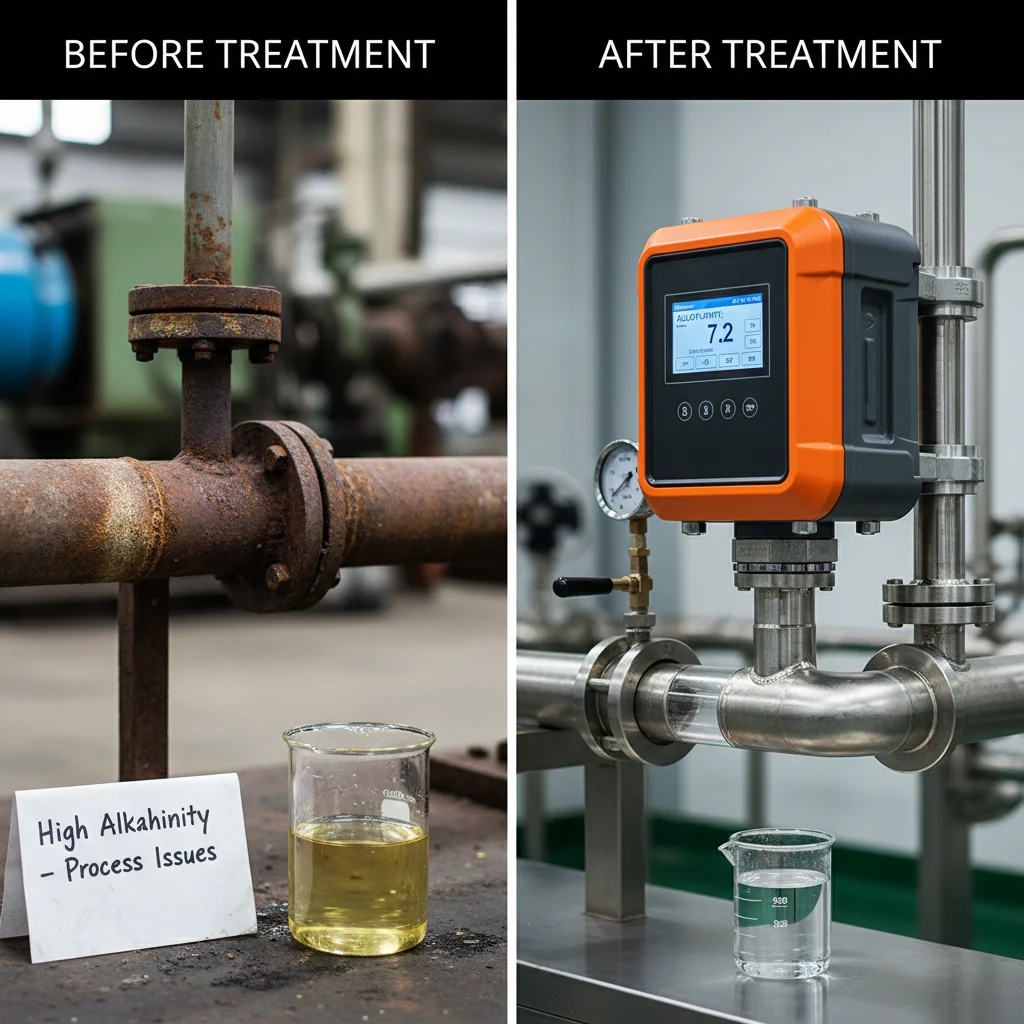
Industrial Water Quality Control Total alkalinity analyzer Guide
Industrial Water Quality Control Total alkalinity analyzer Guide
0%
Table of Contents
Maintaining stable pH levels in complex aquatic systems requires more than just simple monitoring; it demands a precise understanding of a water body's buffering capacity. A Total alkalinity analyzer serves as the critical instrument for measuring the concentration of bases—primarily carbonates and bicarbonates—that neutralize acids, preventing volatile swings in water chemistry.
In industrial wastewater treatment and pharmaceutical manufacturing, failing to regulate alkalinity can lead to inefficient chemical dosing, compromised biological treatment processes, and potential regulatory non-compliance. Automated online analysis removes the variability of manual titration, providing real-time data to maintain optimal operational equilibrium.
This guide explores the technical necessity of alkalinity measurement, the operational advantages of online systems like the PACON 5000, and the strategic factors procurement officers must consider when integrating these instruments into their water quality infrastructure.
✻ ✻ ✻
The Fundamental Role of Alkalinity in Water Chemistry
Total alkalinity is essentially a measure of the water's ability to resist changes in pH, acting as a chemical shock absorber. In environments where carbon dioxide is absorbed or acids are produced—such as in nitrification processes within wastewater plants—alkalinity prevents the pH from dropping to levels that could inhibit microbial activity or corrode infrastructure.
For industrial operators, the distinction between pH (the intensity of acidity) and alkalinity (the capacity to neutralize acid) is paramount. While a pH sensor tells you the current state, a total alkalinity analyzer reveals the stability of that state. This foresight allows engineers to adjust alkaline dosing preemptively rather than reactively.
Without precise measurement, systems often suffer from "pH cycling," where over-correction leads to erratic fluctuations. By implementing high-frequency online monitoring, facilities can ensure that the carbon cycle is balanced, protecting both the biological health of the water and the physical integrity of the piping systems.
Technical Architecture of Online Alkalinity Measurement
Modern online analyzers typically utilize automated potentiometric titration. The system draws a precise sample volume and incrementally adds a standardized acid reagent until a specific endpoint pH is reached. The amount of reagent consumed is then mathematically converted into the total alkalinity concentration, usually expressed as mg/L of CaCO3.
Precision in online alkalinity analysis is determined by the synergy between fluidic accuracy, sensor stability, and reagent purity.
The PACON 5000, for instance, integrates advanced optical analysis and sensor technology to minimize drift. By automating the titration cycle, the instrument eliminates human error associated with manual burettes and colorimetric indicators, which are often unreliable in turbid or colored industrial samples.
Key technical components include high-precision peristaltic pumps for reagent delivery, a temperature-compensated pH electrode for endpoint detection, and a robust controller that manages the timing and calculation. This architecture ensures that measurements remain consistent even under fluctuating flow rates or varying ambient temperatures.
Critical Application Scenarios for Industrial Water Analysis
In wastewater treatment plants, alkalinity monitoring is indispensable for the nitrification process. Nitrifying bacteria consume alkalinity as they convert ammonia to nitrate; if the alkalinity drops too low, the pH crashes, and the biological process ceases. Online analyzers allow for the precise dosing of caustic soda or lime to sustain this critical balance.
Pharmaceutical manufacturers utilize these systems to ensure that purified water meets strict pharmacopeia standards. In these highly controlled environments, any deviation in water chemistry can affect the stability of active pharmaceutical ingredients (APIs), making the continuous monitoring of buffering capacity a non-negotiable quality control requirement.
Additionally, environmental monitoring organizations deploy these instruments in river and lake systems to track acidification trends. By correlating total alkalinity with dissolved oxygen and conductivity, researchers can model the ecosystem's resilience to pollutants and natural atmospheric CO2 absorption.
Evaluating Performance Benchmarks for Automated Analyzers
When comparing automated systems to traditional laboratory methods, the primary metrics for evaluation are measurement frequency, repeatability, and maintenance overhead. While lab tests are highly accurate, they provide only a "snapshot" of the water quality, leaving gaps where critical deviations can occur undetected.
Automated analyzers improve operational stability by providing continuous data streams. This enables the implementation of PID control loops, where the analyzer feeds data directly to a dosing pump, creating a self-regulating system that maintains alkalinity within a narrow, optimized window.
Total alkalinity analyzer Performance Metrics
The data indicates that shifting from manual sampling to an online analyzer significantly reduces the risk of pH excursions and optimizes chemical consumption by eliminating the waste associated with over-dosing based on outdated manual data.
Operational Integration and Maintenance Best Practices
Successful deployment of an online alkalinity system depends heavily on the installation environment and a rigorous calibration schedule. To prevent signal drift, pH electrodes must be cleaned regularly to remove bio-fouling and scaling, especially in wastewater applications where organic loads are high.
The total cost of ownership is minimized not by reducing the initial purchase price, but by optimizing the reagent consumption and extending sensor lifecycles.
Reagent management is another critical factor. Using high-purity, stable reagents ensures that the titration curve remains consistent. Operators should implement a "first-in, first-out" inventory system for reagents to avoid using degraded chemicals that could lead to inaccurate alkalinity readings.
Integration with a SCADA or PLC system allows for centralized monitoring and alarming. By setting "High" and "Low" alkalinity thresholds, plant managers receive immediate notifications of process upsets, enabling rapid intervention before the water chemistry affects the downstream biological or chemical processes.
Evolution Toward Autonomous Water Quality Monitoring Systems
The industry is moving toward fully autonomous water quality stations that integrate multiple parameters into a single analytical hub. Future systems are likely to combine alkalinity, dissolved oxygen, and nitrate sensors to provide a comprehensive "health score" for the water body, allowing for more intelligent, AI-driven dosing strategies.
Advances in sensor materials are expected to reduce the dependency on liquid reagents. While potentiometric titration remains the gold standard for accuracy, the development of more stable solid-state sensors could potentially lower the maintenance burden and reduce the chemical footprint of monitoring stations.
Furthermore, the integration of IoT connectivity allows for remote diagnostics and predictive maintenance. Instead of fixed calibration intervals, the system can monitor electrode impedance and signal response, alerting technicians to perform maintenance only when the sensor's performance actually begins to degrade.
Strategic Selection Guide for Alkalinity Analysis Hardware
Choosing the right analyzer requires a balance between the required measurement precision and the harshness of the operating environment. A system designed for a clean pharmaceutical lab will fail quickly in a raw sewage influent stream due to fouling and corrosive gases.
Procurement teams should evaluate the "Total Cost of Ownership" (TCO), which includes the initial capital expenditure, the cost of proprietary reagents, and the required man-hours for monthly calibration. High-quality systems often have a higher initial cost but lower TCO due to increased reliability and lower reagent waste.
Analysis Approach
Typical Application
Maintenance Need
Decision Driver
Manual Titration
Occasional Batch Testing
Very High (Labor)
Budget constraints
Basic Online Sensor
Stable Industrial Loops
Moderate (Cleaning)
Low-range precision
Advanced Potentiometric
Wastewater Nitrification
Scheduled Calibrations
Process criticality
Multi-Parameter Hub
Environmental Monitoring
Integrated Service
Data correlation
High-Precision PACON
Pharma/Ultra-Pure Water
Low (High Stability)
Strict compliance
Remote IoT Station
Distributed Water Networks
Predictive/Remote
Geographic scale
Ultimately, the selection should be guided by the risk associated with a pH crash. In critical biological processes, the investment in a high-performance automated analyzer is an insurance policy against catastrophic process failure.
✻ ✻ ✻
Frequently Asked Questions
pH measures the current acidity or alkalinity of the water (the intensity), while Total Alkalinity measures the water's capacity to neutralize acids (the buffering capacity). A water sample can have a neutral pH but very low alkalinity, making it susceptible to rapid pH swings.
Online systems provide real-time data, allowing for immediate adjustments to chemical dosing. Lab sampling creates a time lag, meaning operators often react to a problem that has already shifted, leading to over-correction and chemical waste.
Calibration frequency depends on the water quality. In clean water, monthly calibration may suffice. In wastewater or industrial effluents, weekly or bi-weekly calibration is recommended to account for electrode fouling and reagent degradation.
The most common causes include bio-fouling on the pH electrode, air bubbles in the reagent lines, and the use of expired or contaminated titration reagents. Regular cleaning and reagent rotation are the primary solutions.
Yes, potentiometric analyzers (like the PACON series) are ideal for turbid water because they rely on electrical potential rather than visual color changes, making them far more accurate than colorimetric methods in industrial settings.
Most systems use a standardized strong acid, such as hydrochloric acid (HCl) or sulfuric acid (H2SO4), to titrate the sample down to the alkalinity endpoint (typically pH 4.5).
Conclusion
The stability of any water-based industrial process depends on the invisibility of its buffer. Total alkalinity analysis transforms this invisible variable into a manageable data point, allowing facilities to move from reactive crisis management to proactive process optimization.
By integrating high-precision instruments and adhering to rigorous maintenance protocols, companies can ensure operational reliability and environmental compliance. Readers evaluating these technologies can review the relevant product and company information available through www.jensprima.com.
Michael Harrison is a Lead Application Engineer at JENSPRIMA, supporting environmental monitoring organizations. He brings 10 years of field experience in water quality assessment and a deep knowledge of EPA methodologies. Michael assists clients in deploying and maintaining JENSPRIMA instruments for accurate data collection in diverse environmental settings, from rivers
Most websites use cookies. A cookie is a small text file placed on a device to store data for future use
by a web server. We and our third-party partners use cookies to remember your preferences and settings,
help you log in, and analyze the health of our website.
Essential
We use necessary cookies to perform important website functions. For example: used to maintain sessions,
improve performance, route traffic between web servers, detect screen size, determine page loading time,
improve user experience, and conduct audience data statistics. These cookies are essential for the
operation of our website.
Analysis
We allow third parties to use analysis cookies to understand how you use our website, so that we can
improve it. Third parties can also use this information for product development and improvement, and
they may use these products on websites that do not belong to our operations. For example, they can be
used to collect information about the pages you visit and the number of clicks you need to complete a
task. We will use some analysis cookies to optimize content display and enhance user experience.













































































 Download
 Video Center
 Technical Services
 FAQS
 Service Network
 Privacy Policy
 Contact Us