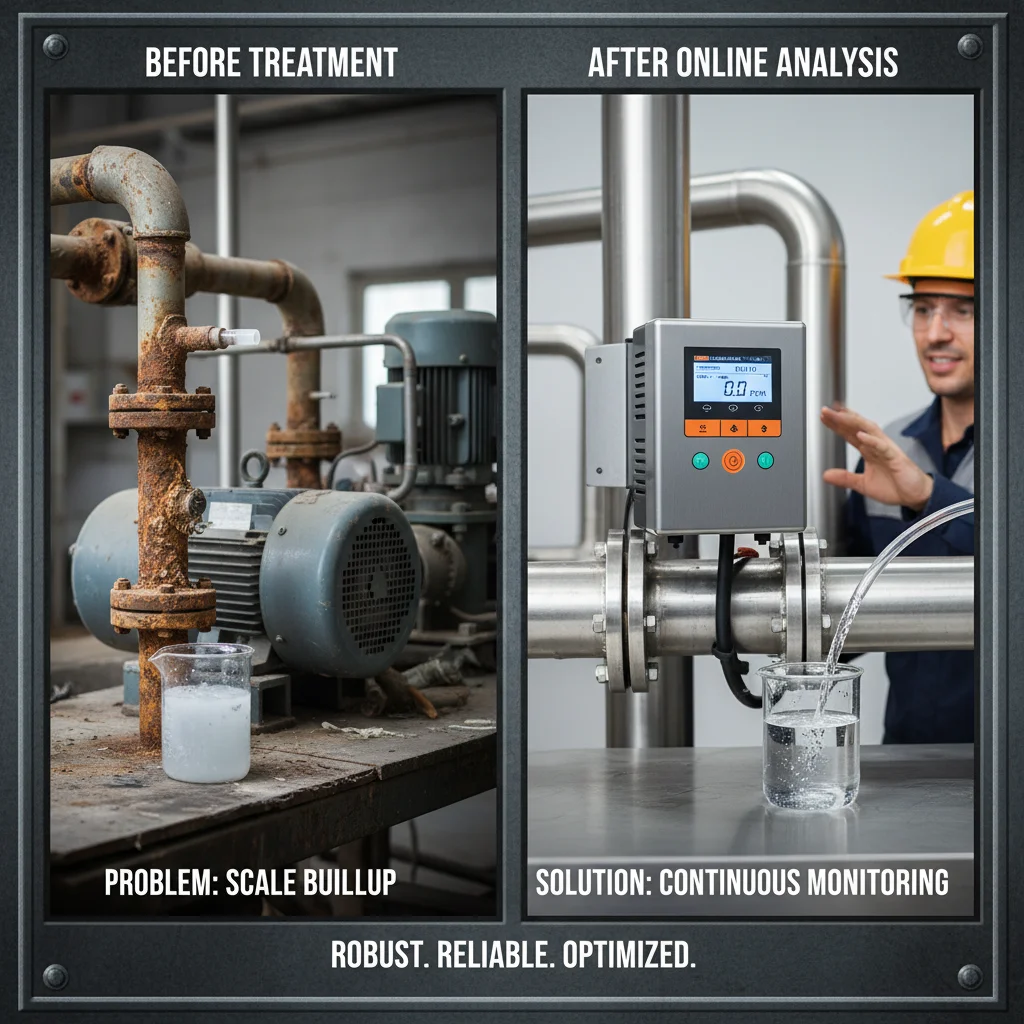
Water hardness is a critical parameter in industrial and municipal water management, representing the concentration of multivalent cations, primarily calcium and magnesium. Without precise monitoring, these minerals can lead to severe scaling in boilers, cooling towers, and piping systems, drastically reducing operational efficiency. A high-performance hardness analyzer is essential for maintaining the longevity of infrastructure and ensuring the purity of processed water.
Globally, the demand for automated water quality monitoring is surging as industries strive to meet stringent environmental regulations and ISO standards. Manual titration methods, while accurate, are labor-intensive and cannot provide the real-time data necessary for immediate corrective action in large-scale plants. The shift toward continuous, online measurement allows facilities to optimize chemical dosing and reduce water waste, contributing to overall sustainable resource management.
The PACON 4200 Online Water Hardness Analyzer represents the pinnacle of this technological evolution, offering a robust solution for the continuous measurement of total hardness. By integrating advanced sensing technology with a user-friendly controller, this hardness analyzer ensures that water quality remains within strict specifications, preventing costly downtimes and equipment failure in demanding industrial environments.

Global Relevance of Hardness Monitoring
In the context of global industrialization, the management of water hardness has moved from a simple maintenance task to a strategic necessity. From the massive desalination plants in the Middle East to the pharmaceutical labs in Europe, the ability to quantify calcium and magnesium levels in real-time is vital. Failure to control these levels often results in "scaling," where mineral deposits insulate heat exchange surfaces, leading to increased energy consumption and potential catastrophic pipe bursts.
The implementation of a reliable hardness analyzer allows companies to adhere to international quality standards such as ISO 14001, focusing on environmental management and waste reduction. By precisely controlling the softening process, industries can minimize the use of ion-exchange resins and chemical regenerants, reducing the chemical footprint of their operations while maximizing the lifespan of their capital assets.
Defining the Online Hardness Analyzer
An online hardness analyzer is a sophisticated analytical instrument designed to measure the total concentration of calcium and magnesium ions in a water stream without the need for manual sampling. Unlike laboratory tests that provide a snapshot of water quality, these devices provide a continuous data stream, allowing for the immediate detection of "breakthrough" in water softening systems.
In modern industry, these analyzers serve as the "eyes" of the water treatment plant. They bridge the gap between raw water intake and high-purity requirements by triggering automatic regeneration cycles of softeners or adjusting the flow of antiscalants. This automation removes the risk of human error and ensures that the water entering sensitive equipment like high-pressure boilers is always within the specified limit.
The core purpose of this technology is to transform a chemical property—water hardness—into a digital signal. This signal can then be integrated into a plant's SCADA or PLC system, enabling a fully autonomous loop where the hardness analyzer dictates the operational status of the entire water treatment chain.
Core Components of the PACON 4200
The PACON 4200 is engineered for durability and precision, featuring a modular design that simplifies maintenance. At its heart, the hardness analyzer utilizes a high-precision photometric or titrimetric detection system that can handle a wide range of hardness concentrations, ensuring accuracy regardless of the source water quality.
One of the standout features of this hardness analyzer is its intelligent reagent management system. By optimizing the consumption of reagents, the PACON 4200 reduces operational costs and minimizes the frequency of manual refills, making it an ideal choice for remote industrial zones where frequent technician visits are impractical.
The system is rounded out by a robust controller that provides clear visual feedback and multiple output options. Whether it is a 4-20mA analog signal or a digital Modbus protocol, the hardness analyzer ensures seamless communication with existing infrastructure, providing the reliability required for 24/7 industrial operations.
Practical Industrial Applications
The application of a hardness analyzer spans various critical sectors. In power generation, it is used to monitor the condensate return and boiler feedwater to prevent the formation of scale on turbine blades. In the pharmaceutical industry, where water purity is a non-negotiable requirement for drug formulation, these analyzers ensure that purified water systems are functioning perfectly.
Furthermore, in large-scale cooling towers, the PACON 4200 helps operators maintain the "cycles of concentration." By monitoring hardness levels, the system can automatically trigger blowdown processes, balancing the need for water conservation with the necessity of preventing mineral buildup in the heat exchangers.
Performance Comparison of Hardness Monitoring Methods
Advantages of Automated Hardness Analysis
The primary advantage of transitioning to an automated hardness analyzer is the drastic reduction in operational risk. Manual testing leaves gaps in data; a softener could fail minutes after a manual test, leaving hours of hard water to enter the system. Automation provides a safety net, ensuring that any deviation from the set point is caught in seconds.
Beyond risk mitigation, there is a significant economic value. By optimizing the regeneration of ion-exchange resins based on actual hardness breakthrough rather than a fixed timer, plants can reduce salt consumption by up to 20%. This not only lowers costs but also reduces the amount of brine discharged into the environment, aligning industrial goals with ecological sustainability.
Future Trends in Water Quality Sensing
The future of the hardness analyzer is leaning heavily toward the "Industry 4.0" philosophy. We are seeing a shift toward IoT-enabled sensors that can upload data to the cloud, allowing engineers to monitor water quality across multiple global sites from a single dashboard. Predictive analytics will soon allow these systems to predict when a softener is likely to fail before it actually happens.
Furthermore, there is a growing movement toward "green chemistry" in reagent development. Future iterations of the PACON 4200 and similar devices are focusing on biodegradable reagents that maintain high precision while reducing the toxic load of the waste stream. This transition is critical as environmental agencies tighten regulations on industrial wastewater.
Integration with AI is another frontier. By correlating hardness data with flow rates and temperature, AI can optimize the entire water treatment cycle, adjusting dosing in real-time to compensate for seasonal changes in raw water quality. The hardness analyzer is evolving from a simple measurement tool into an intelligent decision-making node.
Challenges and Expert Solutions
One of the most common challenges in online hardness measurement is reagent degradation and sensor fouling. In environments with high organic loads, the sensing windows of a hardness analyzer can become coated, leading to drift in readings. The PACON 4200 addresses this through an automated cleaning cycle that ensures the optical path remains clear.
Another hurdle is the complexity of initial calibration. Many operators struggle with setting the zero and span points correctly, which can lead to false alarms. Our expert approach involves providing pre-calibrated modules and a guided setup wizard within the controller, reducing the technical barrier for on-site staff.
Lastly, the cost of consumables can be a deterrent. To overcome this, we recommend a tiered maintenance strategy where reagent consumption is monitored via the hardness analyzer's own diagnostics, allowing for "just-in-time" replenishment and eliminating the need for expensive overstocking of chemicals.
Technical Evaluation of Hardness Analysis Solutions
| Analysis Dimension |
Manual Testing |
Standard Online |
PACON 4200 System |
| Response Time |
Hours (Slow) |
Minutes (Medium) |
Real-time (Fast) |
| Labor Requirement |
High |
Medium |
Very Low |
| Data Consistency |
Subjective (Low) |
Stable (Medium) |
Precise (High) |
| Scalability |
Poor |
Fair |
Excellent |
| Maintenance Effort |
Daily |
Weekly |
Monthly |
| Cost-Benefit Ratio |
Low (Risk high) |
Moderate |
High (ROI fast) |
FAQS
A manual test requires a technician to take a sample and perform a titration, providing a single data point in time. An online hardness analyzer like the PACON 4200 provides continuous, real-time monitoring. This allows for the immediate detection of softener breakthrough, preventing hard water from damaging downstream equipment, whereas manual tests may miss these critical events entirely.
The replacement interval depends on the sampling frequency set by the user. However, the PACON 4200 is designed with an optimized reagent management system that minimizes waste. Most industrial users find that reagents only need to be replenished once every few weeks to a month, significantly reducing the maintenance burden compared to standard analyzers.
Yes, the hardness analyzer is designed for seamless integration. It typically supports 4-20mA analog outputs for basic monitoring and Modbus or other digital protocols for more complex data integration. This allows the device to trigger automatic alarms or start regeneration cycles in the water treatment plant without human intervention.
Turbidity can interfere with the optical measurements of a hardness analyzer. To combat this, the PACON 4200 incorporates a sample conditioning system and automated cleaning mechanisms. For extremely dirty water, we recommend installing a pre-filter to protect the sensor and ensure the highest possible measurement accuracy.
Not at all. The PACON 4200 features a user-friendly interface with a guided calibration process. Users can simply enter the known value of a standard solution, and the controller adjusts the slope and intercept automatically. This ensures that the hardness analyzer remains accurate whether it is measuring ultra-pure water or high-hardness raw water.
Absolutely. By monitoring the exact moment of resin exhaustion, the hardness analyzer ensures that regeneration only occurs when necessary. This eliminates "preventative" regeneration based on timers, which often wastes significant amounts of salt and water, leading to lower operational costs and a smaller environmental footprint.
Conclusion
The implementation of a professional hardness analyzer is no longer an optional luxury but a fundamental requirement for any industry relying on high-quality water. By providing real-time visibility into calcium and magnesium levels, the PACON 4200 safeguards critical infrastructure, optimizes chemical usage, and ensures strict compliance with global environmental standards. The transition from manual, reactive testing to automated, proactive monitoring represents a significant leap in operational efficiency and risk management.
Looking ahead, the integration of AI and IoT will further refine how we manage water hardness, turning measurement tools into predictive assets. We encourage plant managers and engineers to evaluate their current water monitoring gaps and consider the long-term ROI of automation. For more information on how to protect your equipment and optimize your water treatment process, visit our website: www.jensprima.com













































































 Download
 Video Center
 Technical Services
 FAQS
 Service Network
 Privacy Policy
 Contact Us